IThe beginning
Every story has a starting point. This one does not begin in a laboratory, nor in an elite school, nor even in front of a computer. It begins in a bedroom, in a small town, with a boy no one saw coming.
There was a young boy living in the town of Divo. South-western Cote d'Ivoire, a mid-sized town surrounded by cocoa and coffee plantations, far from the bustle of Abidjan. That boy was me. Reserved, I went out little, and when I did I sometimes felt the disdain in the looks people gave me. So I came home and preferred my bedroom. At least it didn't judge me.
On my birth certificate, my name is Gnazou Goudi Bernard. The name Artemix comes from my father, he gave it to me the way one names a hero one is waiting for. It doesn't appear on any paper, but it stuck.
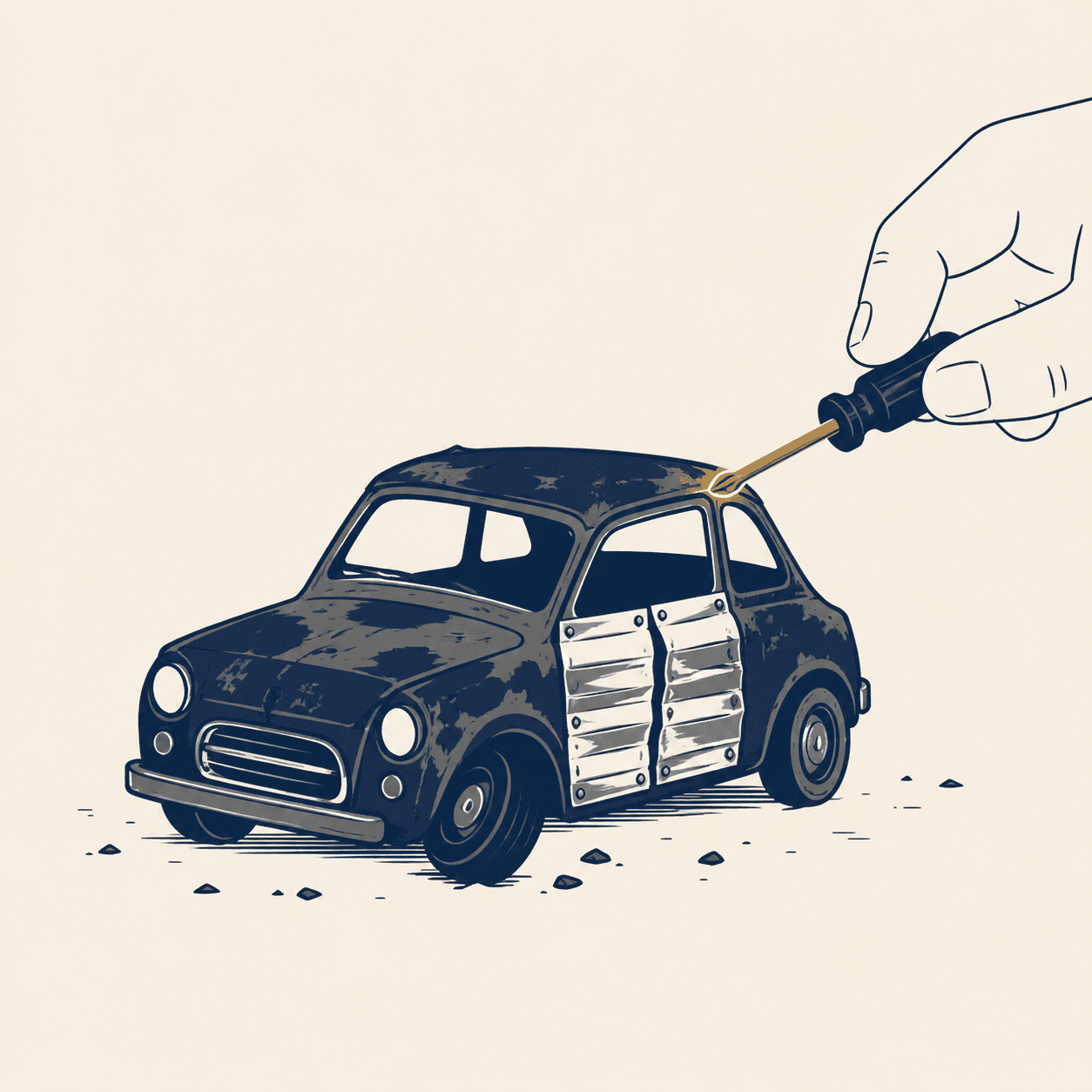
I drew, I folded origamis, I observed, I tinkered. At sixteen, I found a remote-controlled toy car in a rubbish heap, abandoned, partly burnt, the shell shattered. My friends laughed when they saw me take it home, but they were wrong. I repaired it and fashioned a new shell for the toy by hand, from flattened tin cans. The car ran again, probably better than some actual cars in Divo, come to think of it.
No one expected it, I did not expect it myself perhaps, but I did it. That toy car already contained, in seed, everything that would follow: the conviction that one builds with what one has, the refusal to see in waste an end, and a certain methodical solitude.
IIThe phone that changed everything
In tenth grade, I received my first Android phone. For most teenagers an Android was a window onto entertainment, but for me it was a door onto a world. My classmates watched dance videos while I watched Linux terminal tutorials. Different priorities.
I discovered Termux, a Linux terminal emulator that turned a phone into a command post, and I started combing YouTube. Cascades of tutorials, English videos I deciphered laboriously. I downloaded applications, ran commands and learned by trial and error. When I discovered GitHub, I typed commands without fully understanding them, what hackers call script kiddie behaviour, and I own it today with clarity. But curiosity pushed me further: I hacked in tenth grade and wrote my first viruses in eleventh, experiments, not weapons. I wanted to understand how things worked, because understanding was the way I breathed. Incidentally, my phone crashed an incalculable number of times, but it survived. So did I.
Then came an anime, Big Hero 6, the story of a gifted teenager and his robot. Something lit up: robotics, electronics, automated systems, IoT, system programming, all of it suddenly became a horizon.
In 2021, I discovered static web development with HTML and CSS and built my first pages. Then on Facebook I stumbled on words I did not understand: Python, PHP, C, C++, Java. I stopped on Python, searched, downloaded and began. My first programs were basic, sometimes ridiculous, sometimes they crashed my phone, but I continued. In 2022, artificial intelligence entered my field of vision, I was eighteen and had the impression I had already lived three technological lifetimes.
IIIThe productive enclosure
In July 2022, I passed my Baccalaureat C with the lowest honours. Not glorious, but it was a ticket. I aimed high and sat the entrance exam for INPHB, the elite polytechnic of Abidjan, but I failed the second round. I wanted to try ESATIC, a document was missing, and that door closed too. The universe seemed to be testing my patience, but it quickly understood I was not going to give up.
For most, this was the moment when ambitions began to be revised downward. Not for me. I scrolled Facebook, as always, and I kept coming across the posts of a man I did not know, Frederic Boisdron. A robotics and future technologies consultant, creator and editor-in-chief of a robotics magazine for 14 years, his posts talked about robotics, innovation, everything that quietly drove me. Something told me this man might help. On August 31, 2022, I wrote to him: "Hello sir, I'm passionate about AI, and I just passed my bac C, I'd like some guidance." No recommendation, no intermediary, nothing but the quiet boldness of one who has nothing to lose. Honestly, I didn't really believe he would reply: an international consultant, 14 years of running a magazine, and me, a fresh graduate from Divo. The odds were not in my favour.
Frederic Boisdron answered the next day: "The simplest path is to start with a computer science school, then specialise during your university studies. Otherwise, you can start by visiting your local fablab." He told me about Arduino, Raspberry Pi, robots you build yourself, and in a few messages he had given me a direction. I let myself be steered and enrolled in a Bachelor's in Networks and Information Security at the Universite Virtuelle de Cote d'Ivoire. Not INPHB, not ESATIC, a virtual university, a new model, without the prestige my generation still venerated.
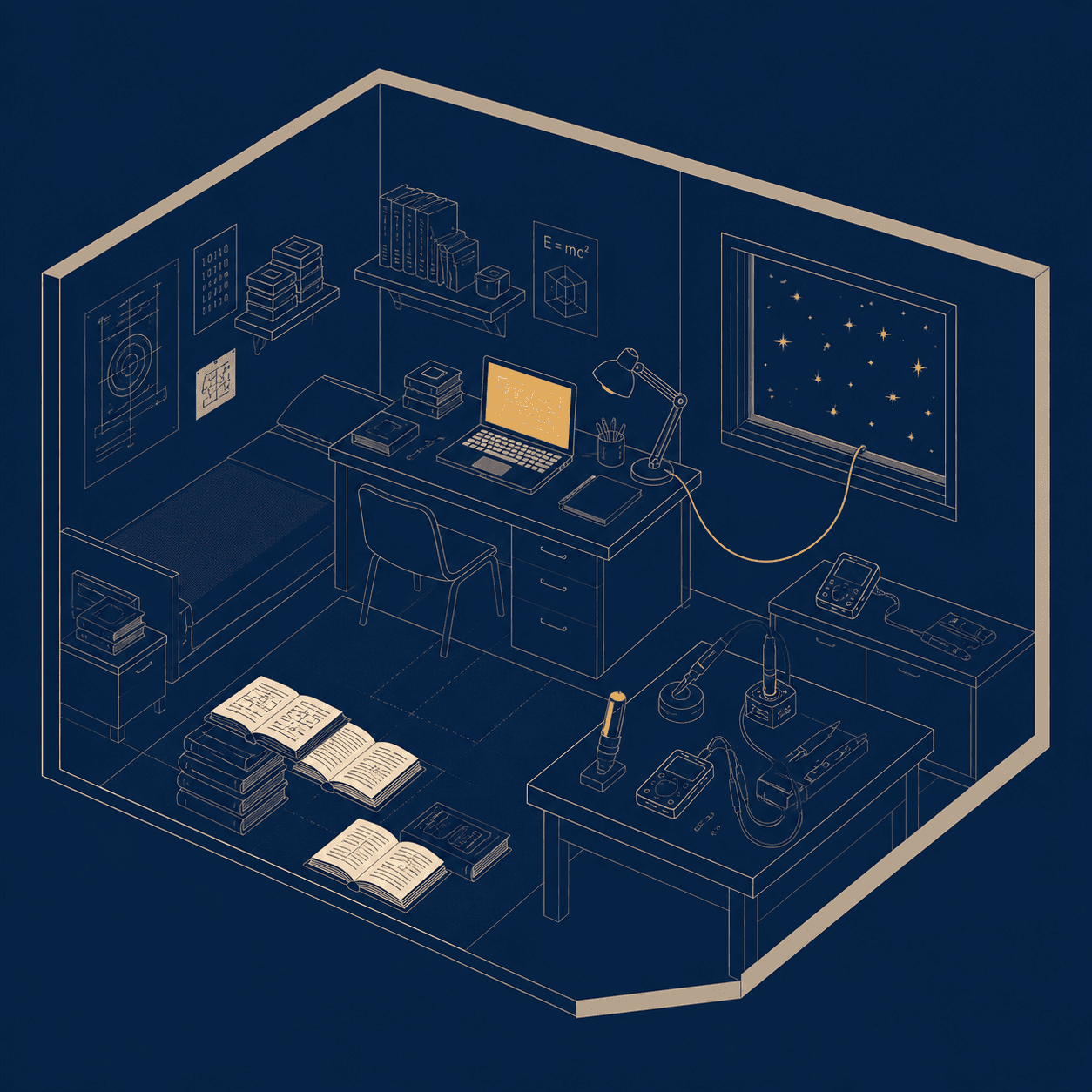
And it was there that began what I today call my productive enclosure. Three years, from first to third year of the Bachelor's, in an almost monastic discipline: home, online classes, studying on one side, self-teaching on the other. The university was virtual, so the longest commute of my day was from my bed to my desk. The only weekly interlude was church on Sunday, no parties, no outings. My friends thought I had vanished and, in a sense, they were right: I had vanished into code.
Every morning, the same ritual: I scanned the latest tech updates, dissected new programming languages, analysed recent releases. This isolation was not a prison, it was a forge, and from this forge emerged advanced programming skills that no university curriculum had taught me.
This isolation was not a prison. It was a forge.
IVLeaving the bedroom
In the second semester of my first year, my sister observed. She saw that I remained too withdrawn, but she did not force me, she arranged. She spoke to a school principal so that I would become the tutor for her children and presented me the offer. I accepted. My sister had understood before me that even forges need air.
At first it was uncomfortable, two of the children were unruly, and for most tutors this was a recipe for failure. But for me it was a pedagogical question. I understood that to teach one had to first inhabit the world of the other, so I established a strange and just balance: we laughed, we shared sweets, we talked about everything, but when the books opened the seriousness was absolute. The transition was so sharp you would have thought I changed personalities.
Work is sacred. One may work for only a little time, but during that time, one gives everything.
The miracle happened: the children passed their year and their mother was astonished. The reputation circulated, a high-school student in Divo even refused every other tutor after me. I did not yet know it, but I had just discovered the other side of my vocation: not only to build, but to transmit.
VAbidjan, digitalisation, the field
In the second semester of my Bachelor's, a call for proposals from the university laboratory took me to Abidjan for a three-month renewable internship, which was renewed once. I plunged into the substantive: modelling, databases, web development. I submitted a project that won, After this first official recognition, the doors of the General Treasury of Divo opened for an immersion internship.
I discovered the underside of the administrative scenery, siloed systems and processes asking to be unified. I developed Tresor-Connect, a secure web platform allowing suppliers to consult the status of their payment orders online in real time. The internship was initially two months, then they extended it by one month, then by yet another month. Apparently, when you solve problems, people don't want to let you leave.
There I also discovered something unexpected: the brotherhood of civil servants, that solidarity through which one supported the colleague who had fallen behind. I left with a certainty: the modernisation of African public service was not a question of tools, it was a question of human beings agreeing to work together.
VIThe year 2025
Several projects in a few months and as many turning points. My CV started looking like an astronaut's logbook, except I hadn't left Ivorian soil yet.
February-March 2025, InondAlert. With a team at ESATIC, I took part in the design of a dual-platform AI-driven system for predicting flood-prone zones. For the first time, I no longer coded to learn, I coded to solve a concrete African problem.
April-May 2025, GeoSmart Vision. Back in 2023, I had launched a personal research project called TerraPulse Vision, born from a traffic accident I suffered in 2020 because of a pothole hidden under mud. The idea: automatically detect road degradation from satellite imagery and artificial intelligence. When MASS 2025 was announced, I proposed the project and the university validated it, renaming it GeoSmart Vision. I became project leader and main advocate, led the team, drafted the entire technical specifications document and developed a machine-learning model for automatic pothole detection. The project won 2nd Prize at the African Space Solutions Market for technical robustness and innovation. May 2025, Technocracks. I joined the team building an intelligent waste-management system integrating geomatics, geospatial data, IoT sensors and QR codes. The project won 1st National Prize at GAIAthon 2025, recognised as the country's top technological innovation. Yes, I helped make bins intelligent, and they won a national prize. Life has its surprises.
In a few months, I had gone from student to twice-prized young innovator, and I was not yet twenty-two.
VIIAdinrin, the FabLab, the Analyst-Designer
In September 2025, asked by a friend, I joined Adinrin Intelligence Systems as Analyst-Designer and Developer of Information Systems, becoming technical lead for project conception and specification writing.
It was there that I developed my methodological precision. I began each project with the four documentary pillars: Detailed Functional Specifications, Technical Functional Specifications, Project Quality Plan, Project Management Plan, then moved on to system design, UML diagrams, BPMN, use cases, sequences. I modelled databases in their full detail, prototyped on Figma, validated the entire analysis and design phase with the CEO, then developed, tested, deployed and maintained. If this sounds like an assembly line, it's because it was one, except the factory was me.
I worked like a man ten years my senior, and this rigour was not learned from a book: it was inherited from the three years of productive enclosure during which I had learned, alone, that no discipline is built without method.
In January 2026, I also became a Consultant at the UVCI FabLab, where I brought my expertise and recommendations to student teams on their innovation projects.
VIIICairo
October 2025. An official envelope, a letter signed by His Excellency Dr Tidiane Ouattara, President of the Council of the African Space Agency. I was invited.
The Continental Forum of GMES & Africa Phase II, second edition, was held from the 1st to the 3rd of December 2025 at AfSA headquarters in Cairo. Dr Ouattara invited me in recognition of my ingenuity and sense of innovation at MASS 2025 and I took the plane. I was twenty-one, it was the first time I had left Cote d'Ivoire, and my passport was so new it still smelled of ink.
Three days straight inside the African Space Agency, I could not believe my eyes. Dignitaries from across the continent, Earth-observation strategies, Pan-African roadmaps. I listened, I took notes and I discovered space in its depth, what it truly is, beyond the images and the articles. I fell in love with this field, and for the first time I had the feeling I had found my true path, the one that gave me a sense of my final destination.
I returned and something inside me had shifted. Not pride, rather a responsibility and a new clarity: the idea that the work to come was no longer mine alone, it belonged to a whole generation asking to enter.

IXBeihang and CubeSat
January 2026. The Regional Workshop on Satellite Technology, organised by CRASTE-LF (Morocco) and RCSSTEAP-China, in partnership with UVCI, Beihang University in Beijing, and the Ministry of Higher Education. Four intensive days in Abidjan.
I took the training on microsatellite (CubeSat) technologies, satellite systems engineering, spacecraft structures and mechanisms, and space propulsion systems, then earned the End-of-Training Certificate N. AP/26-0070, issued on 30 January 2026. In four days, I learned more about satellites than most people will in a lifetime. My brain nearly requested a memory upgrade.
I now held a certification co-signed by one of China's major aerospace universities and started the Master's in Cybersecurity and Internet of Things at UVCI in parallel. The profile was thickening and the pace was accelerating.
XThe Foundation, SIADE, the President
In early 2026, I joined the Eburnie Space Foundation, a pan-African organisation founded in 2025 in Abidjan, whose mission is to promote space innovation for Africa's sustainable development. The Foundation handles the operational implementation of ASPEX 2026, the Africa Space Expo, the largest continental gathering dedicated to African space business, a joint initiative of the African Union and the Government of Cote d'Ivoire. The event will be held from 24 to 26 September 2026 at the Parc des Expositions d'Abidjan. Over 10,000 participants expected, 300 exhibition stands, hundreds of strategic partnerships.
Mr Jean-Paul Enoh, head of the Foundation, brought me in, and Mrs Kocola Paul-Alix, on the ASPEX side, validated. I was 22 and had just joined the team orchestrating Africa's first continental platform for space networking and business development, on my own country's soil.
In April 2026, at SIADE (International Exhibition of AI, Defense and Space), on April 13 and 14, 2026, I was mandated by Mr Enoh and Mrs Kocola to staff the AfSA stand on behalf of ASPEX 2026. It was my second mission. For two days, I represented the African Space Agency on Ivorian soil, at 22. Sometimes, I had to discreetly pinch myself to check this wasn't a particularly ambitious dream.
XILibreville
In February 2026, I received a new official invitation. This time, two letters followed one another: one from AfSA, signed again by Dr Tidiane Ouattara, the other from AGEOS (the Gabonese Agency for Space Studies and Observations), signed by Director General Aboubakar Mambimba Ndjoungui. Two invitation letters for the same person. The boy from Divo who repaired toy cars was now receiving mail from space agencies, and the irony was not lost.
Both letters invited me to the NewSpace Africa Conference 2026, from 20 to 23 April in Libreville. The AGEOS letter justified the invitation by, and these are its exact words, "your recognised expertise and remarkable engagement in the fields of space sciences and Earth observation".
Five hundred participants, fifty-four African countries, decision-makers, investors, space agencies, private sector, international partners. Theme of the edition: Inclusive Growth, Expanding Space Benefits to all Africans. Participation costs were covered by AfSA and I took the plane again.
I returned transformed. For the second time in less than five months, I had watched the African space ecosystem being built before my eyes, not in textbooks nor on YouTube, but in the very room where it was discussed. My love for space only kept growing, and I was becoming more and more confident in myself.
African space is not being built in the future. It is being built now.

XIIToday
At 22, I am Analyst-Designer and Developer of Information Systems at Adinrin Intelligence Systems, Consultant at the UVCI FabLab, member of the Eburnie Space Foundation on the road to ASPEX 2026, CEO and co-founder of OCTAL 360, a young tech startup I am building with two other associates, and Master's student in Cybersecurity and IoT. If anyone asks what I do for a living, the answer takes about five minutes. I have stopped trying to summarise.
I carry with me, quietly, two national and continental prizes, two official invitations from space agencies, a certification co-signed by Beihang University, a public-sector internship at the Treasury, a Bachelor's degree with honours, and three years of silent discipline that laid foundations whose depth few people around me measure.
I also carry, always, in my head, a toy car picked from a rubbish heap at sixteen, and the sentence I say to my students: "Work is sacred. One may work for only a little time, but during that time, one gives everything."
XIIIWhat remains to be written
My story is not that of a young man who has arrived, it is that of a young man who is beginning.
September 2026, Abidjan hosts ASPEX and I will be on the team. 2027 to 2040, OCTAL 360 grows, or fails, or transforms. The years that follow will bring maturation, a doctorate perhaps, the structuring of a voice, the building of a team around me, first missions abroad, the return, the giving, the transmission.
What will distinguish me will not be what I accomplish, for many will accomplish. What will distinguish me is my capacity, maintained, defended, protected, to remain the reserved child from Divo who picked a toy car out of a rubbish heap, even as I come to converse with space agency presidents and take the floor at international conferences.
My true challenge will not be staying humble, because Divo taught me that forever. My true challenge is to make Cote d'Ivoire an essential player in African space, and to prove that the continent can design, build and operate its own space solutions without waiting for others to do it in its place.

If I succeed, my country will no longer need to look at the sky waiting for others to explain what it sees. It will read it for itself.
"Work is sacred. One may work for only a little time, but during that time, one gives everything."
Bernard "Artemix" Gnazou, Cocody, Abidjan · 02 April 2026